Bartlett Epoxy Flooring installs polyaspartic floor coating systems in Bartlett, IL, serving surrounding cities including Winfield, Warrenville, Wood Dale, Bensenville and Campton Hills. Polyaspartic is a fast-curing aliphatic polyurea that we use as a complete floor system and, more often, as the clear topcoat over an epoxy base.
Its appeal is speed and toughness: a coat can cure in hours rather than a day, stays clear under sunlight, and resists salt, fuel and hot tires. Its catch is the same speed. It gives an installer very little working time, so a crew that has not ground the slab properly or mixed in small batches locks its mistakes into the floor within minutes.
Over more than 20 years we have learned where polyaspartic earns its price and where a slower epoxy is the better tool. This page explains the difference.
How a Polyaspartic Coating Behaves
A Fast-Curing Aliphatic Polyurea
Polyaspartic coatings are made by reacting aspartic ester resins with an aliphatic isocyanate, and that reaction runs faster than an epoxy cure. A coat can often take foot traffic the same day. Because the chemistry is aliphatic, it does not yellow in sunlight the way most epoxies do.
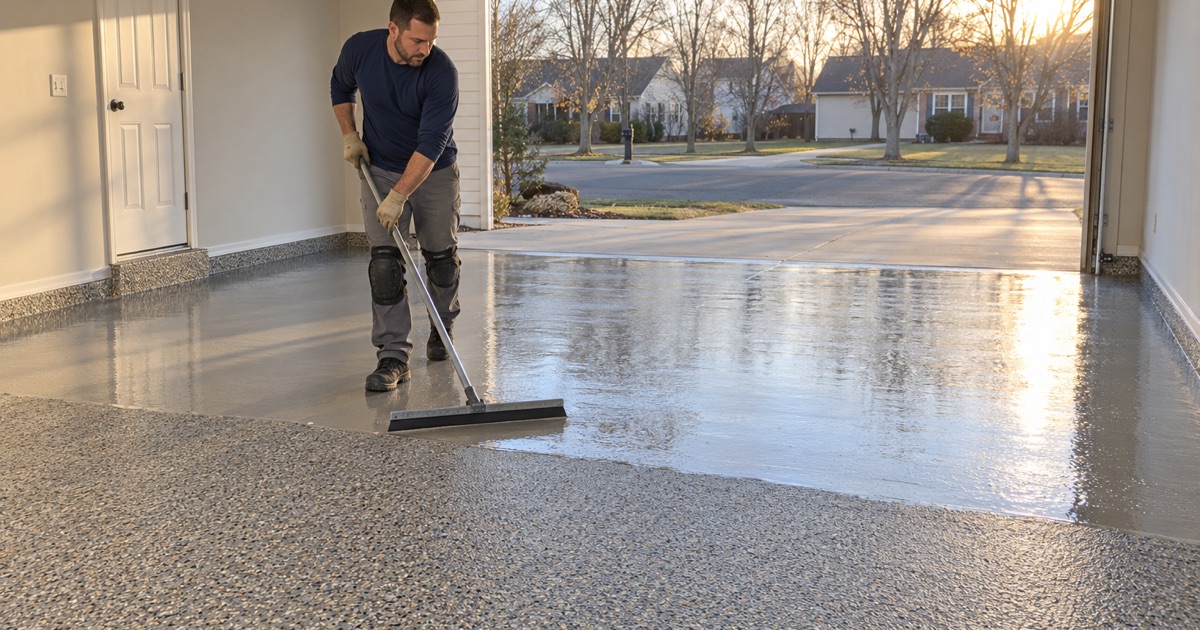
Speed also changes how the coating is installed. We mix in small batches, keep a wet edge moving and plan the order of the room before a single kit is opened, since a puddle left behind cannot be worked once the coat begins to set.
Cold-Weather Tolerance, Within Limits
Many polyaspartics cure at lower temperatures than standard epoxies, which can stretch the season for garage work. That is not a license to coat a frozen floor. The slab still has to stay above the dew point so condensation cannot form under the film, and we measure that spread on site before committing.
Film Thickness and Solids Content
Some polyaspartics are high-solids and build real thickness per coat; others go on thin. A thin coat over unground concrete fails the same way a cheap kit does. The product and the film thickness of each coat are written into our proposal, so you can see exactly what you are paying for.
Polyaspartic Versus Epoxy
Where Polyaspartic Wins
As a topcoat, polyaspartic beats epoxy on ultraviolet stability, scratch and chemical resistance, and resistance to hot tire pickup. It also lets a garage come back into use sooner, which matters to a household with only one place to park.
Where Epoxy Still Belongs
A 100% solids epoxy costs less per mil, wets slowly into a ground surface and builds thickness easily, which makes it an excellent base coat. On a slab with minor surface variation, epoxy has time to level out before it sets. That is why many of our systems pair an epoxy base with a polyaspartic topcoat.
Full polyaspartic systems, from primer to topcoat, make sense when downtime is the main cost, such as a business that must reopen the next morning. When either approach would work, we price both.
What Sits Behind One-Day Floor Offers
Polyaspartic is the chemistry behind most one-day garage floor offers. The coating can cure in a day; the preparation cannot be rushed. A one-day job that skips grinding, moisture testing or crack repair saves time on install day and loses it later when the floor starts to lift.
Commercial and Residential Polyaspartic Floor Coating
Home Garages and Workshops
In a home garage, a polyaspartic topcoat over a vinyl flake broadcast is our usual system. It shrugs off the calcium chloride and rock salt that drip from cars all winter, keeps its color near an open door, and cleans up with a squeegee and a mop.
We often carry the coating up the bottom few inches of the walls as a cove. That keeps salty meltwater off the drywall and lets the whole floor be hosed out.
Shops, Showrooms and Fast-Turn Commercial Floors
Auto shops, showrooms, retail floors and offices choose polyaspartic when the space cannot close for long. A section can be prepared and coated overnight and returned to service the next morning, and larger floors are phased around operating hours.
Floors that see constant hot water or heavy chemical washdown, such as food plants and commercial kitchens, are usually better served by urethane cement. We say so when that is the case rather than selling a coating that will soften.
Building Slip Resistance Into the Topcoat
A clear polyaspartic over a smooth base can be slick when wet. We add texture through the broadcast underneath or a fine grit carried in the topcoat itself, chosen for the room, rather than promising slip resistance without saying how it is built.
Finish Options for Polyaspartic Floors
Clear, Pigmented and Flake Systems
Polyaspartic can be clear over a decorative base, pigmented as a solid color, or used as the binder for a full flake or quartz broadcast. A pigmented coat gives an even, clean look in a workshop or showroom, while a flake system hides wear and adds texture.
Because the topcoat stays clear in sunlight, it keeps the true color of the flake or base beneath it. That matters most on light blends, where an ambering epoxy topcoat would shift the whole floor toward yellow.
Gloss and Satin Topcoats
Most polyaspartic topcoats are high gloss, which brightens a garage and makes the floor easy to wipe. Satin versions hide dust, swirl marks and fine scratches better and suit floors with heavy daily traffic.
We show both sheens on sample boards at the walkthrough. Sheen does not change the protection much; it changes how the floor looks between cleanings.
Our Step-by-Step Polyaspartic Floor Coating Process
Step 1: Inspect, Test and Write the Scope
We check the slab for old coatings, sealers, oil and cracks, run a moisture test and measure the floor. The proposal then names the product line, the number of coats and the film thickness of each, so the finished floor can be held to it.
Step 2: Grind and Repair
The floor is diamond ground or shot blasted edge to edge, with the dust pulled into a vacuum at the machine. Cracks, spalls and control joints are repaired with fast-setting fillers that are compatible with the coating going over them.
Step 3: Prime or Base Coat
Depending on the system, a polyaspartic primer or a 100% solids epoxy base goes down first. If the design includes flake or quartz, it is broadcast into this coat while it is still wet.
Step 4: Scrape, Vacuum and Topcoat
Once the base has cured, loose broadcast is scraped and vacuumed off. The clear polyaspartic topcoat is then rolled in small batches with a wet edge, at the thickness written in the proposal.
Step 5: Cure and Return to Service
We give you written walk-on and drive-on times based on the products and the slab temperature that day. Even with a fast cure, full chemical resistance takes longer than the surface feel suggests, so heavy use waits until that time has passed.
Preparation and Compliance Behind the Floor
Grinding and Moisture Testing First
A polyaspartic bonds no better than the surface under it. Every floor is diamond ground or shot blasted to a concrete surface profile and tested for moisture before the price is final, because vapor moving up through a slab will blister a fast-cure film.
Illinois VOC Limits
Polyaspartic products vary widely in solvent content. Illinois sets VOC limits for floor coatings under 35 Ill. Adm. Code Part 223, those limits bind the person applying the coating, and the Chicago area sits in an ozone nonattainment region. We choose products that fall inside the limits.
- 20+ Years on Concrete
- Moisture Tested First
- Written Scope and Pricing