
Bartlett Epoxy Flooring installs polished concrete floors in Bartlett, IL, serving surrounding cities including Winfield, Warrenville, Wood Dale, Bensenville and Campton Hills. A polished floor is not a coating at all: the slab itself is ground flat, hardened with a densifier and refined with progressively finer diamonds until it reflects light.
That makes the existing concrete the most important part of the job. A slab with level pours and few patches polishes beautifully; one that is wavy, heavily patched or buried under old adhesive needs more work, or a different system. With more than 20 years of grinding slabs behind us, we read the concrete first and tell you honestly what it will look like.
Below is how polishing works, what the design choices are, and where polished concrete makes more sense than a coated floor, and where it does not.
How Concrete Gets Polished
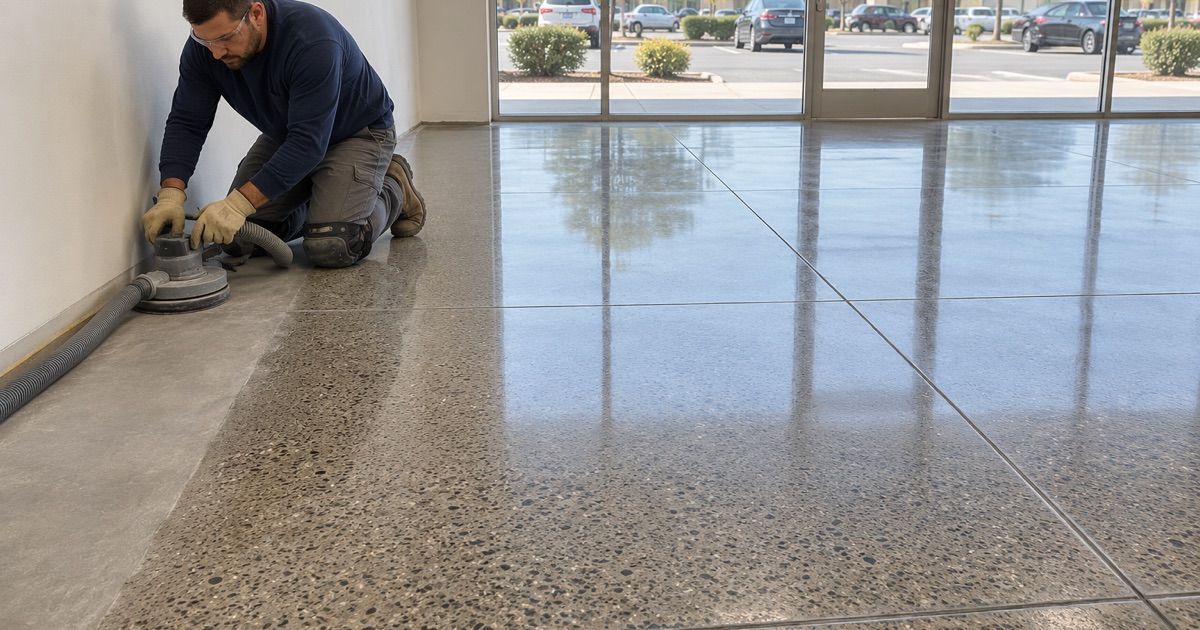
Grinding to Flatten and Open the Surface
Polishing starts with coarse metal-bond diamonds that remove the top skin of the slab along with sealers, glue and old coatings. How deep that first grind goes decides how much aggregate shows in the finished floor. Every pass runs into a vacuum at the machine, which keeps the room clean and keeps concrete slurry out of the floor drains.
Cracks and holes are filled after the first cuts, with a color-matched filler where a patch will stay visible. Large repairs never disappear completely in a polished floor, and we point them out before the job starts rather than after.
Hardening With a Lithium Silicate Densifier
After the grinding passes, a lithium silicate densifier goes on. It reacts with the free lime in the concrete to harden the surface, which helps it take a polish and resist dusting and wear. It is a chemical hardener rather than a film, so there is nothing on the surface to peel.
Polishing and the Protective Guard
Resin-bond diamonds then refine the surface in finer and finer steps until it reaches the sheen you picked. A penetrating guard usually finishes the floor, slowing how quickly oil and spills soak in.
Polished concrete resists stains but is not stain-proof. Wine, coffee, oil and acidic cleaners can still mark it if they sit, so the maintenance routine matters as much as the polish itself.
Choosing the Look of a Polished Floor
Cream, Salt-and-Pepper or Exposed Aggregate
A cream finish keeps the surface paste and shows little or no stone. A salt-and-pepper finish exposes fine sand, and a full aggregate finish grinds deeper to reveal larger stones. Every slab hides different aggregate, so we grind a small test area before you commit to a level.
Satin to High-Gloss Sheen
Sheen is set by the final diamond grit. A satin finish suits garages, basements and working spaces, while a high-gloss finish reads like stone in a showroom or lobby. Higher gloss takes more passes and needs regular burnishing to keep its shine.
Dyes and Color
Concrete can be colored with penetrating dyes during polishing, from warm earth tones to grays and near-black. The dye goes into the surface rather than sitting on it, so the color wears with the concrete instead of chipping. Strong sunlight can fade some dyes, which we weigh for rooms with large windows.
Saw Cuts and Scored Patterns
Decorative saw cuts can divide a polished floor into a grid, a diamond pattern or bands of color, and the cuts can be dyed a contrasting shade. On a slab with random cracking, a planned pattern of cuts can make the cracks read as part of a design rather than damage. We lay out the pattern with you before any blade touches the floor, since a saw cut is permanent.
Commercial Polished Concrete Floors
Warehouses, Distribution and Showrooms
Polished concrete is common in warehouses and showrooms because there is nothing to peel under forklifts and pallet jacks, and the surface bounces light around the room. On heavy-traffic floors we plan for semi-rigid joint filling and edge protection along forklift paths, since a polished slab still chips at an unprotected joint.
Brewster Creek Business Park and similar industrial parks hold the kind of flex and warehouse bays where this works well. We phase large floors in sections so racking, picking and shipping can keep moving while each area is ground.
Retail, Offices and Dining Rooms
Retail stores and offices choose polished concrete for a clean, modern look that cleans up with an auto scrubber. Restaurants can use it in dining rooms, but kitchens full of grease, hot water and harsh cleaners are better served by a sealed resin floor.
Residential Polished Concrete Floors
Basements and Lower Levels
In a basement, polished concrete gives a durable finished floor with no coating for moisture to lift. It still needs a moisture check, since a damp slab can push efflorescence up through the polish and some guards react badly to vapor.
We also ask how the basement has handled water in the past. Polishing does not waterproof anything, and a slab that floods needs its drainage or plumbing sorted out before the floor is finished.
Polished Garage Floors
A polished garage floor works where salt exposure is moderate, but the concrete remains porous. Brine left sitting all winter can etch the surface over time, so for garages that see heavy salt we often recommend a coated system or a guard that is renewed more often.
New Slabs and Additions
A new slab can be planned for polishing before the pour, with the finish, aggregate exposure and joint layout chosen in advance. That gives the best result, because the concrete is placed and finished with the final floor in mind. We still test a new slab before densifying it.
Polished Concrete Versus a Coated Floor
When Polishing Is the Better Choice
Polishing makes sense when the slab is sound, reasonably flat and free of heavy contamination, and when the owner wants a floor with no film to wear through or peel. It suits big open floors where an auto scrubber does the cleaning, and rooms where the look of natural concrete is the point rather than a compromise.
It also avoids the recoat cycle a coating eventually needs. A polished floor is maintained by burnishing and an occasional light repolish, which can be done in sections without closing the whole space.
When a Coating Is the Better Choice
A coating wins where the floor has to be sealed against liquids, such as a commercial kitchen, a wash bay or a garage that sees heavy brine every winter. It also wins on slabs too damaged, patched or contaminated to polish attractively, because a coating can hide what polishing would expose.
Coatings also allow textures that polishing cannot, from a flake broadcast to a gritted quartz floor for wet areas. When an owner is torn between the two, we look at the slab and the use together before recommending either one.
Buildings That Use Both
Some buildings use both: a polished showroom or office in front and a coated service bay or washdown room behind it. The transition is planned with a saw cut or a metal strip so each floor ends cleanly. Doing both with one crew keeps the grinding, scheduling and dust control under a single plan.
Caring for Polished Concrete
Everyday Cleaning
Dust mopping removes the grit that dulls a polish under shoes and carts, and a pH-neutral cleaner handles the rest. Vinegar, bleach and citrus cleaners are best kept away, since acids attack the paste at the surface.
Burnishing and Renewing the Guard
Busy floors are burnished on a schedule to keep their gloss, and the guard is renewed when water stops beading on it. When traffic lanes dull beyond what burnishing fixes, a light repolish with fine diamonds restores them without starting over.
- 20+ Years on Concrete
- Moisture Tested First
- Written Scope and Pricing