
Bartlett Epoxy Flooring handles concrete floor repair in Bartlett, IL, serving surrounding cities including Winfield, Warrenville, Wood Dale, Bensenville and Campton Hills. Most of the repairs we make are the ones a slab needs before it can be coated or polished, and after more than 20 years of opening up floors we map the damage before quoting anything to go on top of it.
Cracks, spalls, popouts, scaling, uneven joints and broken edges all have causes, and a patch that ignores the cause tends to come back. Some damage is cosmetic and simple to fix; some is a sign the slab needs replacement, which is a different job with permits and inspections. We tell you which is which.
This page covers the repairs we make, the materials we use, and the cases where repair is not the right answer.
Crack Repair
Hairline and Shrinkage Cracks
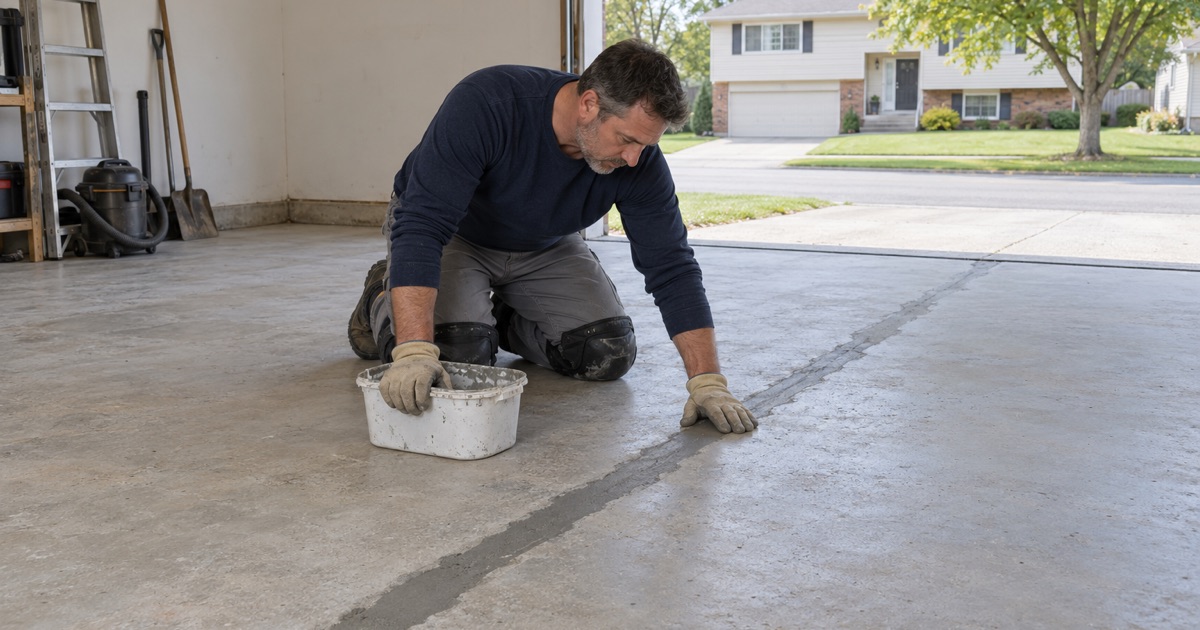
Fine cracks that form as concrete cures and shrinks are common and usually harmless to the slab’s strength. Before a coating, we clean them out, fill them with a rigid epoxy or polyurea filler and grind it flush, so the crack does not telegraph through the finish.
Shrinkage cracks can still move slightly with temperature. Where a crack is active, we use a filler with some flexibility and tell you that a fine line may reappear in the coating over time.
Structural and Moving Cracks
Wide cracks, cracks with one side higher than the other, and cracks that keep growing tell a different story: settlement, heaving or loads the slab was not built for. Filling them hides the symptom without fixing the cause. We note them, explain what they suggest and recommend an engineer’s or concrete contractor’s opinion when the pattern points to a structural problem.
If a crack keeps moving, a rigid coating across it will crack too. Sometimes the better answer is to treat that crack as a joint and carry it through the coating.
Control Joints
Control joints are cut so the slab cracks where it is meant to. Before coating, they can be filled with a semi-rigid filler and coated over for a seamless look, or left open and honored so movement does not crack the finish. On forklift floors, joints are filled to protect their edges from wheel impact.
We explain the trade-off for your floor in plain terms: seamless looks better, while honored joints are more forgiving of movement.
Spalls, Popouts and Scaling
Spalled and Chipped Areas
Spalls are areas where the surface has broken away, often at joints, edges or spots where loads have stressed the concrete. We cut back to sound concrete, clean the cavity and rebuild it with an epoxy or polymer-modified repair mortar that bonds to the slab and grinds smooth.
Repairs are feathered and leveled with the surrounding floor so they disappear under a coating. On a polished floor they remain visible, which we point out before starting.
Scaling From Salt and Freeze-Thaw
Scaling is flaking of the top layer, common near garage doors where calcium chloride and rock salt deicers soak into the concrete and freeze. Loose material is ground away until sound concrete shows, and the low area is rebuilt with a repair mortar.
Coating the repaired slab keeps brine on the surface in the winters that follow, which is the main reason a scaled garage floor gets coated at all.
Popouts and Surface Voids
Popouts are small conical holes left when an aggregate particle near the surface breaks out, and bugholes are voids from trapped air. Both are filled and ground flat before coating, because a thin coating bridges over them and leaves a dimple or a pinhole behind.
Leveling, Low Spots and Edges
Uneven Joints and Lippage
When one slab panel sits slightly higher than its neighbor, a small lip can be ground down. A larger difference means the slab has moved, and grinding only treats the surface of that problem.
We measure lips during the walkthrough. Small ones are ground as part of the prep, while large or changing ones get a frank recommendation instead.
Low Spots and Ponding Water
Low spots that hold water can be built up with a leveling compound or an epoxy mortar before coating. Where water should run toward a floor drain, we check the slope so the repair does not create a new puddle somewhere else.
Broken Edges and Door Thresholds
Edges at garage doors, loading docks and doorways take impact and freeze-thaw damage. We rebuild them with high-strength repair mortar, sometimes against a form, so the coating ends on a solid line rather than on crumbling concrete.
At a garage door, the repair is shaped so the door seal still closes cleanly against the floor and keeps snowmelt outside.
Around Floor Drains, Sump Pits and Trenches
Concrete around floor drains, sump pits and old plumbing trenches is often patched, cracked or sunken, because it was poured after the main slab. We cut out loose material, rebuild the area to the right height and slope toward the drain, and make sure grates and pit lids still sit level.
A trench that was backfilled poorly can keep settling after it is patched. When the patch has already dropped once, we tell you that the backfill below it may be the real problem before rebuilding the surface again.
When Repair Is Not Enough
Heaved, Settled or Broken Slabs
A slab that has heaved, sunk significantly or broken into pieces cannot be fixed with surface repair or a coating. It needs replacement, or leveling by a specialist. We tell you that before you pay for a coating that would fail.
In Bartlett, replacing a slab is new concrete work that the village regulates. Its codified rules set garage slab thickness and the stone base beneath it and call for a pre-pour inspection, so we check current requirements with the Building Division before the job goes ahead.
Moisture-Driven Damage
Some damage is caused by water: efflorescence, a coating lifted from below, or deterioration around a leaking drain. Repairing the surface without dealing with the moisture sends the repair back toward failure, which is why moisture testing is part of our scope.
When the source is plumbing, drainage or a sump that cannot keep up, that gets fixed first and the floor repair follows.
- 20+ Years on Concrete
- Moisture Tested First
- Written Scope and Pricing