
Bartlett Epoxy Flooring installs basement floor epoxy in Bartlett, IL, serving surrounding cities including Winfield, Warrenville, Wood Dale, Bensenville and Campton Hills. In more than 20 years of coating lower-level slabs, one lesson has held: a basement floor is judged by what is happening underneath it, not by the color on top.
A basement slab sits against soil on every side. It can carry water vapor up from below, take water in from a backed-up drain, and hold decades of paint and adhesive from earlier finishes. Epoxy handles foot traffic, laundry and workshop abuse well, but only on a slab that has been tested, ground to bare concrete and judged dry enough to hold it.
Here is how we decide whether a basement is ready, what we do when it is not, and what a coated basement floor can and cannot do for you.
Reading the Basement Before Coating It
Signs of Past Water
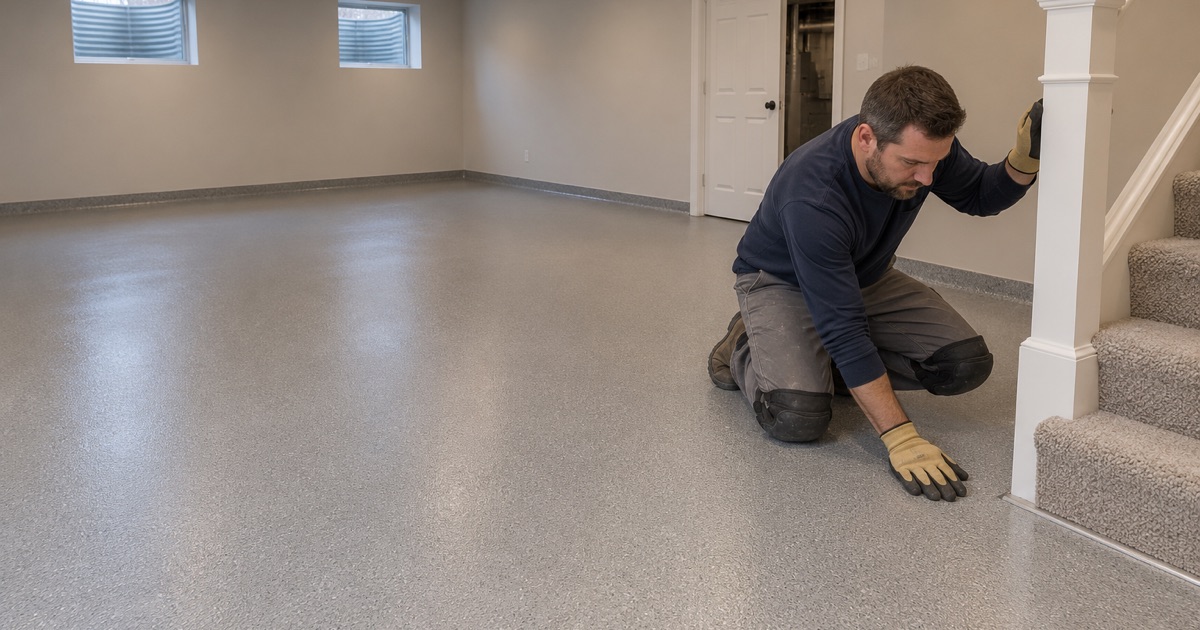
Water lines on the walls, rust at the feet of metal shelving, white deposits along cracks and a sump that runs often all tell a story. We look for them on the walkthrough and ask about backups and seepage, because a coating sealed over a slab that floods will lift as soon as water gets beneath it.
A coating does not stop seepage, a sewer backup or a sump that cannot keep up. Those are drainage and plumbing problems, and they get fixed before the floor.
Moisture Testing the Slab
Newer basement slabs were usually poured over a vapor retarder, but older ones and patched areas may not have one. We screen with an ASTM D4263 plastic sheet test and measure with calcium chloride kits or in-situ relative humidity probes, comparing the readings with the limits the product is rated for.
When a slab reads high, a moisture-mitigation primer rated for that level can go down first. When it reads beyond what any primer is built to hold, we tell you not to coat yet.
Efflorescence and Hydrostatic Pressure
White mineral deposits on a basement floor are efflorescence: salts carried up by water and left behind as it evaporates. They show that moisture is moving, and in heavier cases that groundwater pressure is pushing it. Hydrostatic pressure under a slab can raise a coating in blisters, and coating warranties commonly exclude it.
Bartlett Basements: Floods, Backups and Overhead Sewers
After the September 2008 Flood
In September 2008 floodwater reached homes around Beaver Pond at the Brewster Creek headwaters, and a county-funded basin and bypass were finished in 2013. Basements in the area flooded again over Fourth of July weekend in 2026. A basement that has taken water needs cleanup, drying and repairs before any floor goes in.
Materials for a basement that may flood again should tolerate water. FEMA Technical Bulletin 2 lists flood damage-resistant materials, and sealed concrete fares far better than carpet or laminate, but no floor keeps the water out.
Overhead Sewer Conversions Come First
For owner-occupied homes with sanitary sewer backups, the village’s Overhead Sewer Program pays up to $10,000 toward an overhead sewer. That conversion usually means cutting and trenching the basement slab, so we schedule the floor after the plumbing, never before it.
The program is limited to owner-occupied single-family homes, and the village sets its own rules for applying. Ask about it before the floor is planned, because a fresh coating cut open for a trench a year later is money spent twice.
Sump Pits and Ejector Basins
Sump pits, floor drains and ejector pump basins have to keep working on a coated floor. We grind and seal to their edges, keep the coating out of the pit and leave lids and drain grates removable for service.
Where a floor drain sits in a low spot, the coating is feathered so water still finds it. A pump that cycles often is a sign worth mentioning before the job, since it says something about the water under the slab.
Building the Basement Floor
Removing Paint, Patching and Tile Adhesive
Many basements have been painted, patched and tiled several times over. Every layer comes off by grinding so the epoxy bonds to concrete, with the dust going straight into a vacuum. Old nine-inch tile and black mastic that could contain asbestos are tested before any grinder touches them.
Matching the System to the Room
A laundry room gets a seamless coating coved at the walls so water stays on the surface. A workshop gets a thicker, chemical-resistant build, a home gym or playroom a finer texture, and a finished family room may suit a metallic or solid color epoxy under a satin topcoat.
Each choice is written into the proposal as a product line, a coat count and a finished thickness, so the floor can be checked against what you paid for.
Coved Edges and Wall Transitions
The joint where a basement slab meets the foundation wall is where water, dirt and pests collect. Carrying the coating a few inches up the wall as a cove closes that joint and makes a spill easy to wipe out of the corner.
Where drywall or framing comes down to the floor, we stop the coating at a clean line instead and leave the base trim to the finish carpenter. Either way, the transition is agreed before the job rather than improvised on the day.
Odor, Ventilation and Living Upstairs
A basement shares air with the rest of the house. We choose low-odor, low-solvent products inside the Illinois VOC limits, ventilate during the install and give you clear times for when the space can be used again.
Furnaces and water heaters in a basement mechanical room are coated around rather than moved. We keep solvent-borne primers away from any appliance with a pilot or burner and choose water-based or high-solids products in those rooms.
Our Step-by-Step Basement Floor Epoxy Process
Step 1: Walkthrough, History and Testing
We look at the walls, drains and sump, ask about past water, and test the slab for moisture. The findings go into a written scope, and home jobs over the Illinois threshold get a written contract and the state’s consumer-rights pamphlet before work begins.
Step 2: Protect the House
Stairs, doors and finished rooms next to the work area are sealed off, and the room is cleared of furniture and storage. Appliances that stay are covered and worked around.
Step 3: Grind Off Old Finishes and Repair
Paint, adhesive and patching are ground away to bare concrete, cracks are filled and low spots are leveled. Everything is vacuumed until the slab is clean enough for the primer to soak in.
Step 4: Prime, Coat and Topcoat
A moisture-mitigation primer goes down where the readings call for it, then the epoxy body coat with any flake or color, then the topcoat. Each coat is applied at the thickness listed in the proposal.
Step 5: Cure and Move Back In
You get written times for walking on the floor and returning furniture. Felt pads under chair and table legs keep the new topcoat from scratching in the first weeks.
What a Coated Basement Floor Will Not Do
It Is Not Waterproofing
Epoxy keeps spills on top of the floor; it does not hold back water coming through the slab or the walls. A basement with active seepage needs drainage work, and we will not sell a coating as a substitute for it.
If water does reach a coated floor, cleanup is easier than with carpet, and the floor can usually be dried and kept. That is a real benefit, but it is a benefit after the fact, not protection.
It Is Not Radon Mitigation
Sealing a floor does not reduce radon in any tested, dependable way, and in Illinois radon mitigation is licensed work overseen by IEMA. If your radon test comes back high, a licensed mitigator is the right call, and the coating can follow once their system is in.
What the Warranty Leaves Out
Coating warranties cover the product against defects, not the slab against the ground. Moisture vapor transmission and hydrostatic pressure are the exclusions we explain first, before the job is sold.
- 20+ Years on Concrete
- Moisture Tested First
- Written Scope and Pricing