
Bartlett Epoxy Flooring installs ESD flooring in Bartlett, IL, serving surrounding cities including Winfield, Warrenville, Wood Dale, Bensenville and Campton Hills. Electrostatic discharge flooring is a resin floor built to carry static charge away from people and equipment in a controlled way, and it is specified by electrical resistance rather than by color or gloss.
It is a specialty system that only works as part of a whole static control program: a grounded floor, the right footwear, grounded workstations and regular testing. In more than 20 years of floor work we have learned that the floor is easy to get wrong without noticing, because an ESD floor reading out of range looks exactly like one reading in range.
This page explains the types of ESD floor, how they are built and tested, and what you should expect to see in the proposal.
Where ESD Flooring Is Used
Electronics Assembly and Repair
Circuit boards, chips and assembled electronics can be damaged by a discharge far too small for a person to feel. Assembly lines, rework benches and repair rooms use ESD floors so that every step drains charge to ground instead of storing it. The floor works together with heel grounders or ESD footwear.
Without the right footwear, even a correctly installed floor does little, which is why we ask about your program before specifying a system.
Server Rooms, Labs and Control Rooms
Server rooms, laboratories and control rooms use static-dissipative floors to protect equipment and keep charge from building as people move around. These rooms often need a seamless, cleanable finish with good chemical resistance as well. We design the system so both requirements are met in one build.
Areas With Flammable Vapors or Powders
Where solvents or fine powders are handled, a static spark can be an ignition source, and conductive flooring may be part of the safety design. Those spaces are governed by the facility’s own engineering and fire protection requirements. We install to the specification those set rather than choosing the range ourselves.
Static-Dissipative Versus Conductive ESD Floors
Static-Dissipative Systems
Static-dissipative floors drain charge slowly enough to avoid a sudden discharge but quickly enough to prevent buildup. They are the common choice for electronics assembly, server rooms and general static control areas. The resistance range is set by the facility’s ESD program, which often follows the ANSI/ESD S20.20 standard.
We confirm that range in writing before the job, because the product, the primer and the grounding plan all follow from it.
Conductive Systems
Conductive floors have lower resistance and move charge to ground faster. They are used where a specification calls for them, such as some specialized manufacturing and hazardous handling areas. Conductive floors also change which footwear and equipment are acceptable, so the facility’s engineers make that call.
Choosing Between Them
The right system depends on what is being protected, the footwear program and any safety requirements in the space. We do not guess at it. Your quality or safety team’s specification sets the target, and we propose a product and build rated to meet it.
How an ESD Floor Is Built
Surface Preparation and Moisture Testing
An ESD floor starts like any other resin floor: the slab is diamond ground or shot blasted to a profile, cracks are repaired and moisture is tested. Moisture matters even more here, since a damp slab can affect both the bond and the electrical readings.
Old coatings are removed completely. An unknown coating left under the system can interfere with the conductive layers and the path to ground.
Conductive Primer and Copper Grounding Strips
Most ESD systems use a conductive primer layer and copper grounding strips bonded to the slab and connected to a building ground point. The number and placement of ground points follow the manufacturer’s system requirements and the room layout. Grounding is what makes the floor work, so it is checked before the finish coats go on.
We coordinate the ground connections with your electrician or facility team, who confirm the building ground itself.
Static-Control Epoxy Body and Topcoat
The body coat is an ESD epoxy containing conductive materials, applied at the thickness the system calls for. Some systems add a static-control topcoat for wear and chemical resistance. Colors are limited compared with standard coatings, and darker grays and blues are common because conductive fibers can show in light colors.
Planning an ESD Floor Project
What We Need Before Quoting
To price an ESD floor accurately, we need the resistance range your program requires, the test methods named in it, the room layout and the location of available building ground points. We also ask what chemicals, carts and equipment the floor will carry, since the topcoat has to survive daily use without drifting out of range.
With that in hand, the proposal names the product system, the primer, the number and position of ground points, the coat thicknesses and the testing to be done at handover.
Scheduling Around Production
ESD floors usually go into rooms that are busy every day, so equipment has to be moved and the room taken out of service while the system cures. We plan the work by room or zone, often over weekends or shutdown weeks, and agree on the date for testing before anything is moved back.
Where a room cannot be emptied all at once, it can be split into phases with a grounded seam between them, so each section is fully functional on its own.
Testing and Maintaining an ESD Floor
Resistance Testing After Installation
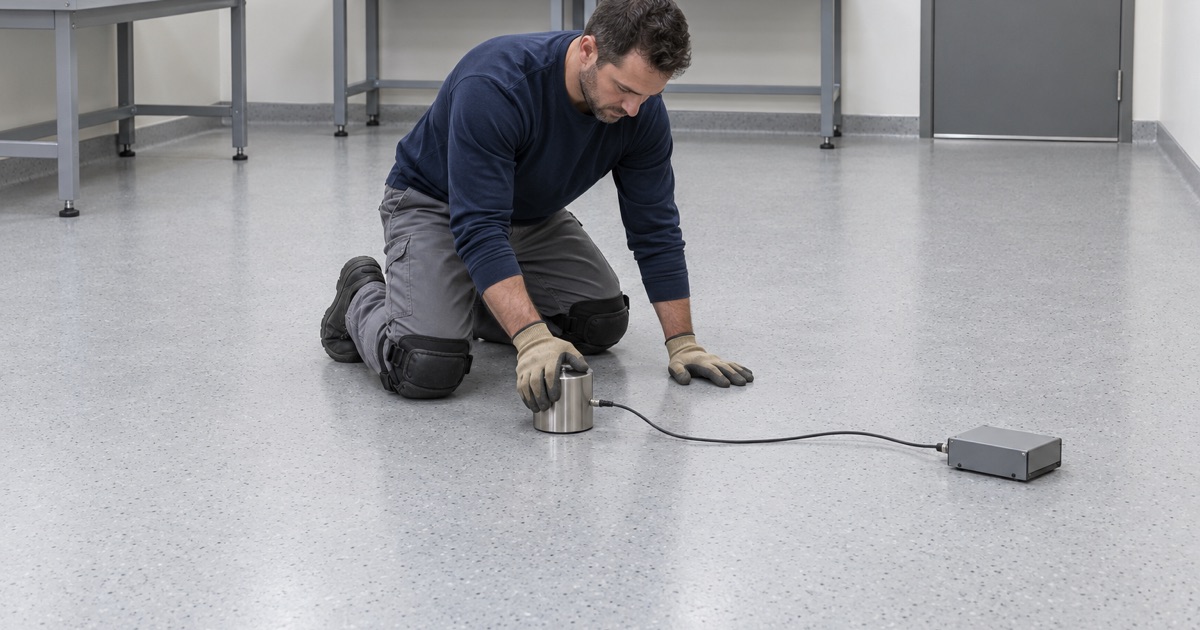
Once cured, the floor is tested for resistance to ground and point-to-point resistance at multiple locations, using the test methods named in the specification. Readings are recorded and handed over with a floor plan, so your ESD program starts with a baseline.
Any area reading outside the range is corrected before the floor is handed over.
Cleaning Without Insulating the Floor
Some floor finishes, waxes and residue-forming cleaners leave an insulating film that pushes readings out of range. ESD floors are cleaned with products approved for static-control surfaces, and waxing is avoided unless the finish itself is ESD rated.
Periodic Re-Testing
ESD floors should be retested on the schedule your program sets, and after any repair or recoat. A floor that reads in range on day one can drift as it wears or is cleaned with the wrong product, and regular testing catches that before parts are damaged.
- 20+ Years on Concrete
- Moisture Tested First
- Written Scope and Pricing