
Bartlett Epoxy Flooring installs industrial epoxy flooring in Bartlett, IL, serving surrounding cities including Winfield, Warrenville, Wood Dale, Bensenville and Campton Hills. Industrial floors carry forklifts, pallet racking, steel wheels, chemicals and heat, and after more than 20 years on concrete we specify them by the load and exposure they will see, not by a catalog color.
The local employer base makes that work familiar. Brewster Creek Business Park holds food distribution, manufacturing and fabrication tenants, and parks like it across the area are full of warehouse, flex and production space. Each of those floors has a different failure waiting for it, and the specification is how we prevent it.
This page covers the systems we install, how an industrial slab is prepared, and how we keep a plant running while its floor is redone.
Industrial Floor Systems
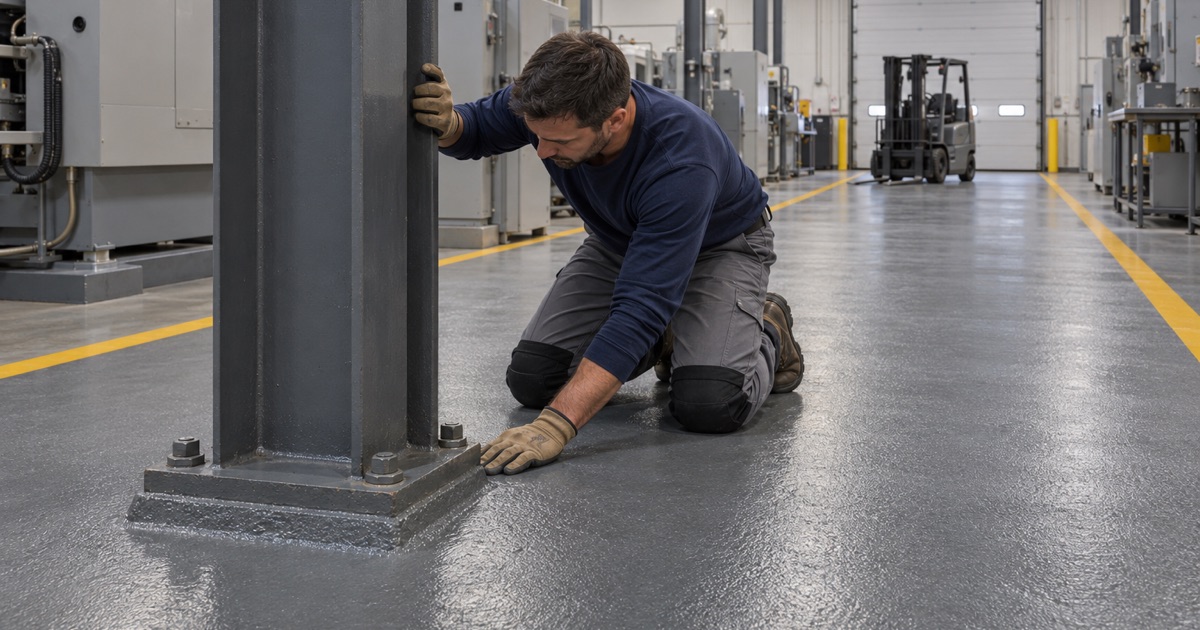
High-Build 100% Solids Epoxy
A high-build epoxy system, applied in multiple coats or as a slurry, is the workhorse for warehouses and manufacturing floors. It builds thickness that resists forklift wear and impact, bonds hard to properly prepared concrete and handles a wide range of oils and chemicals. A urethane or polyaspartic topcoat adds abrasion and ultraviolet resistance.
Thickness is the main variable, and it is the one most often cut short on a low bid. Our proposal states the thickness of every coat, so the finished floor can be checked against it.
Epoxy Mortar and Troweled Systems
Where floors take heavy impact, steel wheels or dropped parts, a troweled epoxy mortar much thicker than a coating gives far more protection. Mortar systems can also level rough or damaged slabs and rebuild worn areas in a single step.
They take longer to install than a coating and need a deeper surface profile, usually produced by shot blasting rather than grinding alone.
Urethane Cement for Heat and Washdown
Urethane cement tolerates hot water, steam cleaning, thermal shock and many acids and fats that would break down an epoxy. It is our usual specification for food processing, beverage plants and washdown areas, and it can be installed with a coved base that runs up the wall for sanitary seams.
Urethane cement is also more tolerant of moisture in the slab than many epoxies, which helps on older plant floors that were poured without a vapor retarder.
Preparing an Industrial Slab
Shot Blasting and Diamond Grinding
Industrial floors are usually shot blasted across the open field to a profile suited to the system, with diamond grinding along walls, columns, drains and racking. All dust is captured by vacuum, and nothing is washed toward floor drains or storm inlets.
The profile is checked against reference chips before any coating goes down, so the system gets the grip its maker designed it for.
Oil and Chemical Contamination
Plant floors often carry decades of oil, hydraulic fluid and process residue. Contaminated concrete is degreased and ground repeatedly until clean, and areas too saturated to clean are cut out and rebuilt with repair mortar.
We test for contamination and moisture before pricing, so surprises show up in the proposal rather than halfway through the job.
Joints, Cracks and Spalls
Forklift wheels hammer joint edges and widen spalls. Joints are filled with a semi-rigid filler that supports wheel loads, and spalled edges are rebuilt before coating. Moving cracks are treated as joints and carried through the coating rather than buried under it.
Getting the joints right often decides how long the whole floor lasts, since that is where most industrial coatings start to fail.
Designing for How the Plant Works
Forklift Aisles, Racking and Docks
Forklift aisles and turning areas see the heaviest wear, and dock edges take impact from pallet jacks and trailers. We specify those zones thicker or with a mortar system and finish them with a harder topcoat. Rack legs and anchor points are coated around, or the racking is reset after the floor cures.
Chemical Exposure Zones
Battery charging stations, chemical storage, maintenance shops and wash areas each expose the floor to different chemicals. We ask for the chemicals in use and choose a system rated for each zone, rather than one coating for the whole plant.
Secondary containment areas can be lined with a chemical-resistant coating that runs up curbs and walls, so a spill stays where it can be cleaned.
Safety Lines and Walkways
Aisle lines, pedestrian walkways, hatched hazard zones and forklift paths can be coated directly into the floor in safety colors. They last far longer than tape or paint and are installed on the same schedule as the floor itself.
Slip Resistance in Wet and Oily Areas
Areas that see water, oil or product spills get a broadcast aggregate and a textured topcoat. Slip resistance is specified by the aggregate size and topcoat thickness for each zone, so a dry warehouse aisle is not as rough as a wash bay.
Coolers, Freezers and Temperature Swings
Cold storage rooms and freezer docks put floors through temperature swings that crack rigid coatings and pop poorly bonded ones. Urethane cement and certain flexible systems handle those swings far better than standard epoxy, and they can be installed at lower temperatures when the room cannot be warmed for long.
Where a freezer cannot be shut down at all, the floor work is planned around a defrost or a scheduled outage, with the system chosen for the temperature the slab will actually be at on install day.
Keeping the Plant Running
Phasing and Shutdowns
Most plants cannot stop for an entire floor. We divide the work into zones, coordinate with production and shipping schedules, and use weekends, holidays and planned shutdowns. Fast-curing systems can return a section to service within hours.
The phasing plan is agreed in writing before work begins, so production, shipping and our crew all work from the same map.
VOC Limits and Ventilation
Under 35 Ill. Adm. Code Part 223, Illinois limits VOCs at 340 grams per liter for industrial maintenance coatings and 250 for floor coatings, and those limits apply to whoever applies the product. We choose compliant products and ventilate work areas, which matters in a plant where people keep working nearby.
- 20+ Years on Concrete
- Moisture Tested First
- Written Scope and Pricing